
Fury (2014, directed by David Ayer) is a fictional account of an American tank crew fighting their way deep into Germany in April 1945. The war may be over in days or weeks—we don’t know which, and neither does the crew. Led by Sgt. Don Collier (Brad Pitt), the tank crew is most at home inside their steel beast, a Sherman tank. The scenes shot within that cramped, dark hull help ensure that this war film will have a place among the all-time great films of that genre.
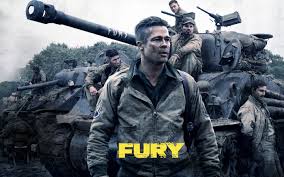
The dialogue, violence, and utter hopelessness of war combine in Fury to make something we have never collectively seen before on the silver screen. What exactly is it? David Denby of The New Yorker nailed it when he called it a “war horror movie.”
Comparatively, in Steven Spielberg’s Saving Private Ryan (1998), the horror of war hits us in the face in the opening scenes of the action on Omaha Beach on June 6, 1944, but after 20 minutes the terror fades away to a more common approach to war movies. The action separates out from the real war being fought for Normandy, focusing instead on the quest of a handpicked platoon sent on a special mission to rescue one man. It leads us inextricably to one of the movie’s most memorable quotes, from Sgt. Horvath, played by Tom Sizemore:
Someday we might look back on this and decide that saving Private Ryan was the one decent thing we were able to pull out of this whole God-awful, shitty mess.
Here the audience is deliberately shifted away from the absolute meaninglessness of human life in total war, and together we embark on a great piece of Hollywood fiction. In Fury, the horror of total war never leaves us. Sgt. Collier has been fighting since North Africa, and it shows—from the burns on his back to his interactions with his crew.
In one poignant scene inside the apartment of two German women, Collier’s crew has arrived for a diversion, and we hear from them of the horrors of war they experienced in the Falaise gap in the summer of 1944. It was in Falaise where an entire German army was trapped and destroyed in just days—even pilots flying high above the battlefield were overpowered by the stench below on the ground of the burning, bloated corpses of the dead and dying. The message is clear. This crew has already seen hell and is living it every day. Inside that apartment, we don’t know quite what will happen—no morals restrain Collier’s men. It is only their respect for each other that drives the scene to a conclusion, albeit a horrific one. This movie never loses sight of total war.
The combat scenes are overpowering. Tank shells bounce, skim and ricochet. Men die without knowing what hit them. Others die agonizing deaths—often burning alive in their tanks. Women and children are killed. Prisoners are murdered. In-between the horror we see small glimpses of human decency, but they are fleeting.
We live in the shadow of the “Greatest Generation”—but Fury reminds us that those sentiments were imposed on those that fought after the war was over. Defeating Adolf Hitler and Nazi Germany was a herculean task to save western civilization. Men fought, not out of a desire to do the right thing, but because they had to. There was no other way—kill or be killed. Total war was pure horror, and this film never, ever loses sight of the fact that war is not something to be celebrated. The cost was just too high. Thankfully, this time Hollywood got it right.